
 LIMITED EDITION VINCENT VAN GOGH WRIST WATCHES
 LIMITED EDITION SALVADOR DALI WRIST WATCHES
 LIMITED EDITION WALL CLOCKS
 LIMITED EDITION BUTTERFLY THEME WALL CLOCKS
 LIMITED EDITION FISH THEME WALL CLOCKS
 LIMITED EDITION TOP GEAR THEME WALL CLOCKS
 LIMITED EDITION SAKURA THEME WALL CLOCKS
 LIMITED EDITION WIND MILL WALL CLOCKS
 LIMITED EDITION DIAMANTE PENS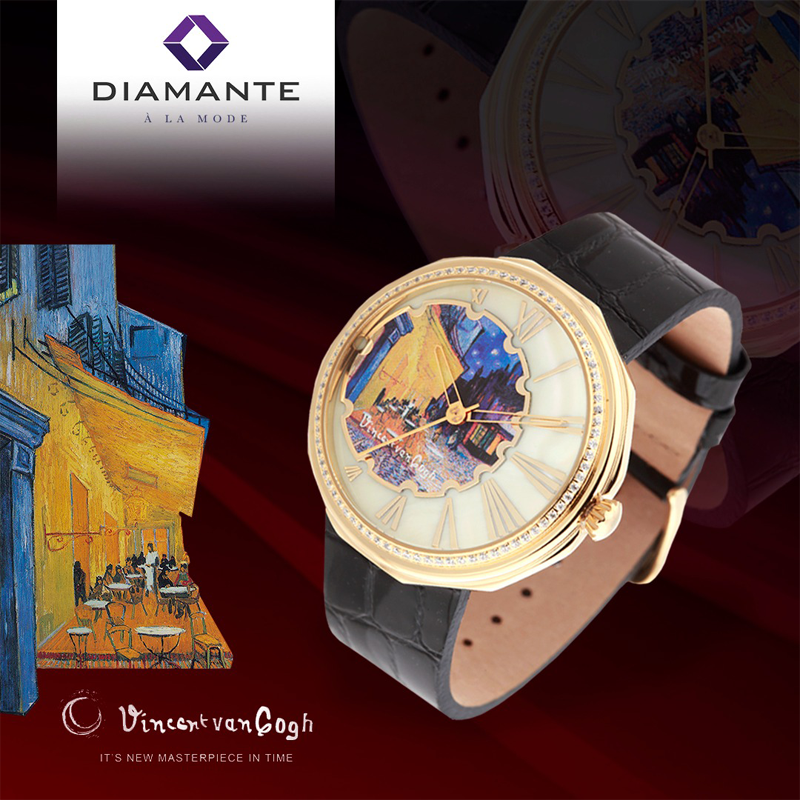
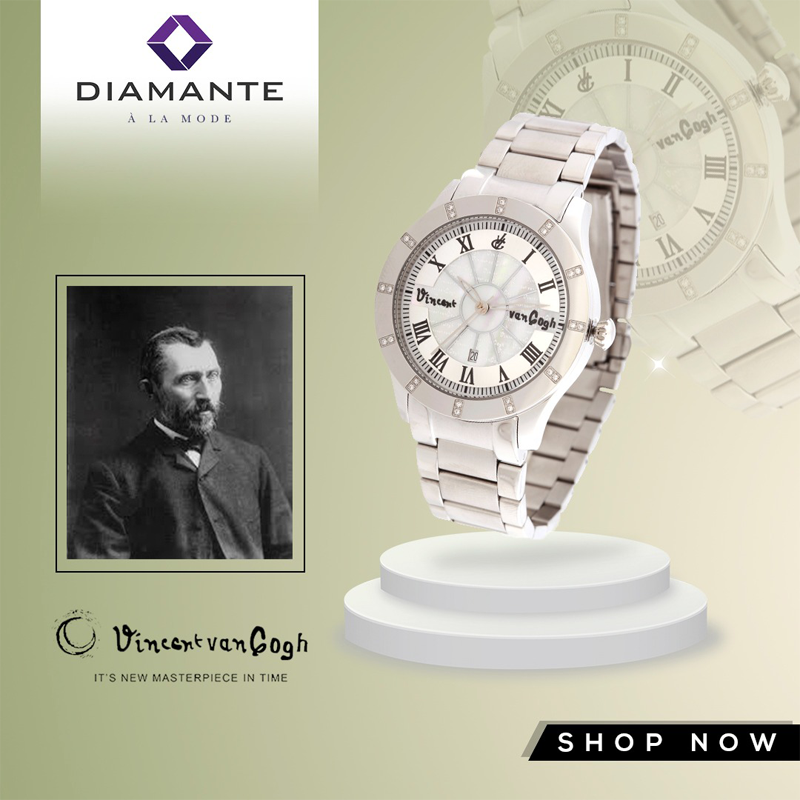

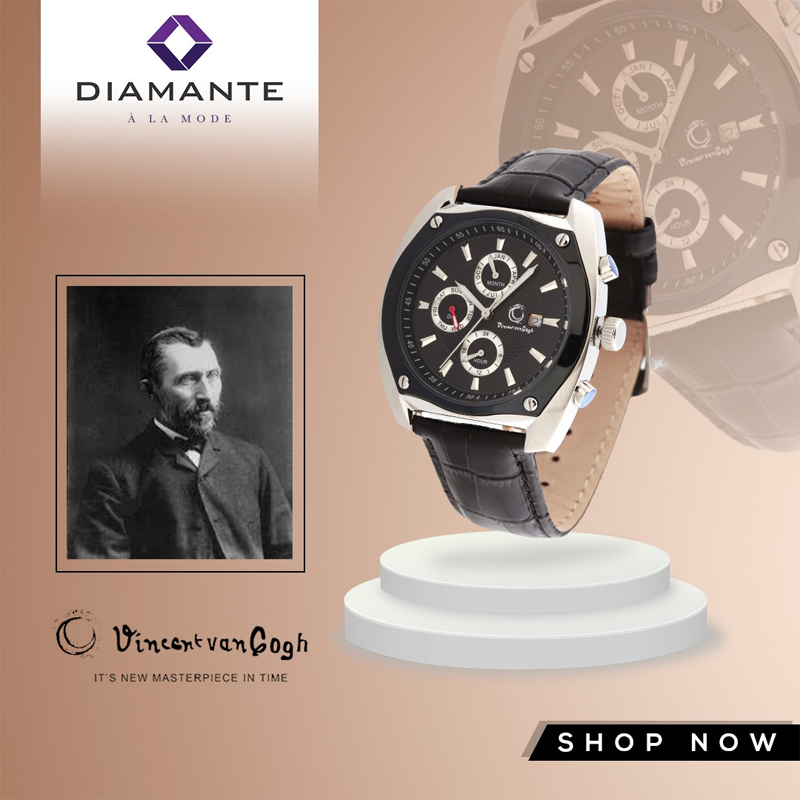
Vincent Van Gogh Wrist Watches
Unique watches for unique people.
Vincent van Gogh, in full Vincent Willem van Gogh, (born March 30, 1853, Zundert, Netherlands—died July 29, 1890, Auvers-sur-Oise, near Paris, France), Dutch painter, generally considered the greatest after Rembrandt van Rijn, and one of the greatest of the Post-Impressionists. The striking colour, emphatic brushwork, and contoured forms of his work powerfully influenced the current of Expressionism in modern art. Van Gogh’s art became astoundingly popular after his death, especially in the late 20th century, when his work sold for record-breaking sums at auctions around the world and was featured in blockbuster touring exhibitions. In part because of his extensive published letters, van Gogh has also been mythologized in the popular imagination as the quintessential tortured artist.
Van Gogh, the eldest of six children of a Protestant pastor, was born and reared in a small village in the Brabant region of the southern Netherlands. He was a quiet, self-contained youth, spending his free time wandering the countryside to observe nature. At 16 he was apprenticed to The Hague branch of the art dealers Goupil and Co., of which his uncle was a partner.
Van Gogh worked for Goupil in London from 1873 to May 1875 and in Paris from that date until April 1876. Daily contact with works of art aroused his artistic sensibility, and he soon formed a taste for Rembrandt, Frans Hals, and other Dutch masters, although his preference was for two contemporary French painters, Jean-François Millet and Camille Corot, whose influence was to last throughout his life. Van Gogh disliked art dealing. Moreover, his approach to life darkened when his love was rejected by a London girl in 1874. His burning desire for human affection thwarted, he became increasingly solitary. He worked as a language teacher and lay preacher in England and, in 1877, worked for a bookseller in Dordrecht, Netherlands. Impelled by a longing to serve humanity, he envisaged entering the ministry and took up theology; however, he abandoned this project in 1878 for short-term training as an evangelist in Brussels. A conflict with authority ensued when he disputed the orthodox doctrinal approach. Failing to get an appointment after three months, he left to do missionary work among the impoverished population of the Borinage, a coal-mining region in southwestern Belgium. There, in the winter of 1879–80, he experienced the first great spiritual crisis of his life. Living among the poor, he gave away all his worldly goods in an impassioned moment; he was thereupon dismissed by church authorities for a too-literal interpretation of Christian teaching.
His understanding of the possibilities of painting was evolving rapidly; from studying Hals he learned to portray the freshness of a visual impression, while the works of Paolo Veronese and Eugène Delacroix taught him that colour can express something by itself. This led to his enthusiasm for Peter Paul Rubens and inspired his sudden departure for Antwerp, Belgium, where the greatest number of Rubens’s works could be seen. The revelation of Rubens’s mode of direct notation and of his ability to express a mood by a combination of colours proved decisive in the development of van Gogh’s style. Simultaneously, van Gogh discovered Japanese prints and Impressionist painting. All these sources influenced him more than the academic principles taught at the Antwerp Academy, where he was enrolled. His refusal to follow the academy’s dictates led to disputes, and after three months he left precipitately in 1886 to join Theo in Paris. There, still concerned with improving his drawing, van Gogh met Henri de Toulouse-Lautrec, Paul Gauguin, and others who were to play historic roles in modern art. They opened his eyes to the latest developments in French painting. At the same time, Theo introduced him to Camille Pissarro, Georges Seurat, and other artists of the Impressionist group.
| Brand | DIAMANTE A LA MODE |
|---|---|
| World's Greatest Artists | Vincent Van Gogh |
| Materials | Metal, Leather |
| Display Type | Analog |